
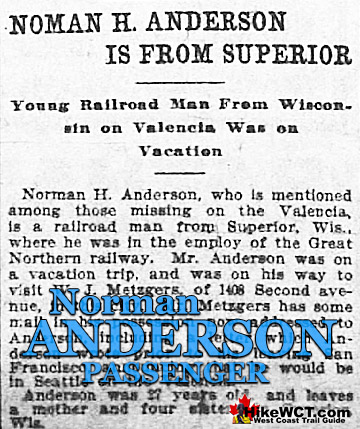
Norman Anderson - Passenger

Norman H. Anderson, a 22-year-old railroad employee from Superior, Wisconsin, was a first-class passenger aboard the SS Valencia when it met disaster on January 22–24, 1906. The infamous shipwreck off the rugged west coast of Vancouver Island, British Columbia, claimed approximately 136 lives when the coastal passenger steamer ran aground in heavy fog and broke apart in pounding surf. All women and children aboard perished.

Background and Journey

Norman’s story stands out for the brief hope his friends and family clung to in the days after the wreck—fueled by rumors that some passengers had been rescued by another vessel—before the reality of his loss set in. Norman H. Anderson worked for the Great Northern Railway, where he had been connected with the superintendent’s offices in Superior, Wisconsin. In late 1905, he resigned his position to take a pleasure trip over the West.

He left Superior in mid-December and traveled to Los Angeles before heading north. He planned to sail from San Francisco to Victoria and then on to Seattle, with the intention of returning home by the end of January 1906 to take a new position with the Northwestern Fuel Company.

Friends in Superior received word that Norman intended to sail on the Valencia. He was en route to visit W.J. Mezgers in Seattle, who later confirmed receiving a letter from Anderson stating he would arrive aboard the ship. He was the son of G. J. Anderson, who owned a large farm near Superior and was involved in local dock construction projects.

The Valencia Disaster and Initial Uncertainty

The Valencia departed San Francisco on January 20, 1906, bound for Victoria and Seattle. It struck the rocks late on the night of January 22 in heavy fog. Over the following 36–40 hours, chaotic evacuation attempts, failed lifeboats, and freezing conditions led to the loss of nearly everyone aboard.

In the days immediately after the wreck, confusion and hopeful rumors circulated widely. On January 26, 1906, the Duluth News Tribune reported that friends in Superior feared Norman was among the lost, noting his name on the passenger list and his planned voyage.

However, by mid-February, a glimmer of hope emerged for Norman’s family and friends. The Evening Telegram (February 13, 1906) carried the headline “SUPERIOR BOY MAY BE SAVED” and reported that relatives had received encouraging news from the West. The article described information passed to Louis J. O’Farrell of Santa Rosa (brother of the Valencia’s first officer, John O’Farrell). According to First Assistant Engineer Thomas F. Carrick, a boat commanded by John O’Farrell—with several crew and passengers—had left the wreck and headed toward a reef rather than directly to shore. Carrick believed this boat may have been picked up by the steamship Empress of Japan, which was in the vicinity. Friends clung to the possibility that Norman had been one of the passengers in that boat and would soon be heard from when the Empress reached Yokohama.

Confirmation of Loss

Tragically, the hopeful reports proved unfounded. Norman H. Anderson was among those lost in the disaster. His body was never recovered. He is listed in detailed victim compilations as a first-class passenger who perished with the wreck. No specific survivor accounts mention him by name, and he was not among the small number who reached shore on rafts or were rescued.

Norman’s story reflects the painful uncertainty that followed the Valencia tragedy—families and friends grasping at rumors amid incomplete passenger lists and conflicting reports, only to face the devastating finality of the loss.