
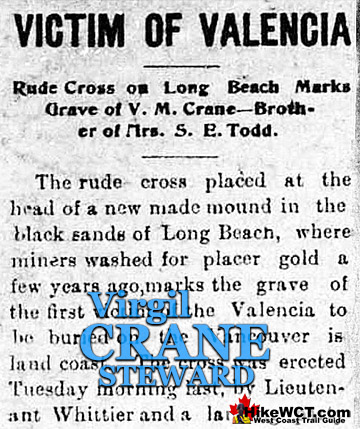
Virgil Crane was a steward on the Valencia, whose body was found along Long Beach, near Tofino in the days after the wreck. Virgil Montieth Crane, affectionately known as “Berty,” was born on May 10, 1866, in Freeport, Stephenson County, Illinois. He was the son of James W. Crane and Cynthia Hartness (Van Winkle) Crane. The family later moved to Washington state and settled in the Yakima area.

The Valencia Disaster

 Shipwreck on the West Coast Trail1. The Valencia Shipwreck on the West Coast Trail2. The Voyage Shipwreck on the West Coast Trail3. The Boats Shipwreck on the West Coast Trail4. The McCarthy Boat Shipwreck on the West Coast Trail5. The Bunker Party Shipwreck on the West Coast Trail6. On the Valencia Shipwreck on the West Coast Trail7. The Rafts Shipwreck on the West Coast Trail8. The Turret Raft Shipwreck on the West Coast Trail9. The Rescue Ships Shipwreck on the West Coast Trail10. The Aftermath Shipwreck on the West Coast Trail11. The Survivors Shipwreck on the West Coast Trail12. The Lost 

The West Coast Trail

Shipwreck on the West Coast TrailPrologue Shipwreck on the West Coast Trail1: The West Coast Trail Shipwreck on the West Coast Trail2: When to Hike & Fees Shipwreck on the West Coast Trail3: Trailheads Shipwreck on the West Coast Trail4: Getting There Shipwreck on the West Coast Trail5: Considerations Shipwreck on the West Coast Trail6: Campsites Shipwreck on the West Coast Trail7: Shipwrecks Shipwreck on the West Coast Trail8: Routes Shipwreck on the West Coast Trail9: Sights & Highlights

Virgil married Marguerite “Maggie” I. Crane, and the couple made their home in San Francisco, California. By the early 1900s, Virgil was working as a steward and head pantry man aboard coastal passenger steamships.

The SS Valencia Disaster

Virgil Crane was on duty in the steward’s department when the ship struck the rocks. As the vessel broke apart and massive waves pounded the hull, he showed extraordinary courage. Instead of saving himself, he spent his final hours comforting women and children on board.

Lieutenant Whittier of the United States Revenue Cutter Grant later wrote a letter of praise to Virgil’s mother, Cynthia Crane. In it he described Virgil’s actions:

“While the storm was raging and the waves were buffeting and tearing at the vitals of the Valencia… Crane spent all of his time in comforting the women and children. He had a life preserver at hand, and could easily have escaped a watery grave with his splendid physique. He chose rather to die a hero than to leave the women and children of the ill-fated ship to their horrible fate. His cheering presence and courageous words helped many a soul to meet its fate bravely. Those who were rescued hallow his memory, and call him the ‘heroic steward.’”

Virgil had followed the sea for many years and had survived previous shipwrecks, but he never turned his back on duty or failed to help the weak.

Recovery and Initial Burial on Vancouver Island

Virgil’s body washed ashore at Long Beach near Clayoquot (close to present-day Tofino) in the days after the wreck. It was found on February 1, 1906, by local Indigenous people and recovered by the crew of the U.S. Revenue Cutter Grant. The body was identified by a memorandum book and a membership card from the Pacific Coast Marine Cooks’ and Stewards’ Association.

Because of the remote location and rough conditions, Virgil was buried on the spot in the black sands of Long Beach — the first victim of the Valencia to receive burial on Vancouver Island soil. A simple wooden cross was placed at the head of the grave by Lieutenant Whittier and a landing party from the Grant.

The San Francisco Call reported on February 4, 1906: “A rude cross placed at the head of a newly made mound in the black sands of Long Beach… marks the grave of the first victim of the Valencia to be buried on the Vancouver Island coast.”

Exhumation and Return Home

In early March 1906, Herbert S. Noice of the Seattle undertaking firm Noice & Co. traveled to Ucluelet to recover identified remains. After a difficult journey involving rough seas, a mule, and a sled hauled overland, he successfully brought Virgil’s body back to the mainland. Virgil’s brother, W.M. Crane, arranged for the exhumation and transport.

Funeral and Final Resting Place

The body arrived in Washington state in mid-March. A funeral service was held on Monday, March 19, 1906, at Flint & Shaw’s undertaking parlors. A large number of friends gathered to pay their respects to the brave young hero.

The Yakima Herald reported on March 21, 1906: “Amid Tears, Virgil Crane, Victim of Valencia Disaster, Is Laid to Rest.”

Rev. Alfred H. Henry of the Methodist Episcopal Church delivered a moving eulogy praising Virgil’s noble sacrifice. Virgil was laid to rest at Tahoma Cemetery in Yakima, Washington, beside his father, James W. Crane.

Legacy

In September 1906, Virgil’s widow, Marguerite I. Crane of San Francisco, filed a lawsuit in Superior Court against the Pacific Coast Steamship Company. She sought $25,300 in damages, alleging negligence caused the wreck.

Today, Virgil Montieth “Berty” Crane is remembered not just as a victim of the SS Valencia disaster, but as the “Heroic Steward” whose courage and humanity shone in the darkest moments. His selfless decision to stay behind and comfort others, rather than save himself, remains a powerful example of bravery and duty.