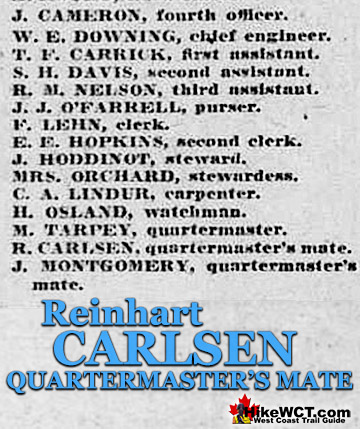
Reinhart Carlsen - Quartermaster

Reinhart Carlsen, a 46-year-old quartermaster aboard the SS Valencia, perished in the maritime disaster of January 22–24, 1906. Carlsen was at the wheel steering the ship at the exact moment she struck the reef. His body was never recovered. Reinhart Carlsen was a native of Norway. At 46 years old, he was an experienced seaman serving as quartermaster on the Valencia. A quartermaster was a senior deck rating responsible for steering the vessel, maintaining a sharp lookout, handling the wheel and compass, and assisting with deck operations during watches. These duties required steady nerves and constant vigilance, especially in the foggy, stormy coastal waters of the Pacific Northwest.

The Valencia Disaster – The First Hour

Just before midnight on Monday, January 22, 1906 (approximately 11:50 p.m.), the Valencia struck a rock or ledge a few hundred metres from the shore of Vancouver Island. With her bow lodged on the underwater obstruction, the stern drifted to point toward the shore. In the first 5 or 6 minutes, an estimated 6 feet of water had already poured into the ship. Captain Oscar M. Johnson ordered the engines full astern in an attempt to beach her. Moments later, she backed onto a reef just 18 metres from the vertical cliffs, surrounded by crashing waves and huge rock shelves.

At the moment of impact, Reinhart Carlsen was at the wheel, actively steering the ship (referred to as “Clawson” in the Victoria Daily Colonist inquiry report of February 9, 1906). The location—now near KM 18 on the modern West Coast Trail—was a brutal stretch of steep cliffs, dense impenetrable forest, deep ravines, and freezing rain with a few centimetres of snow on the ground. Passengers initially believed they were near the Washington coast south of Cape Flattery, adding to the confusion.

Frank Lehn, freight clerk on the Valencia, described the immediate chaos:

“When the ship first struck there was wild excitement. The screams of men, women and children mingled in awful chorus with the shriek of the wind, the dash of the rain and the roar of the breakers. It was pandemonium… Great seas broke over the ship… One after another in rapid succession they rolled over us and people were carried away in bunches. Their agonized shrieks could be heard above all the fiendish roar of the wind and sea.”

Captain Johnson quickly ordered the lifeboats lowered to the saloon rail. In the first chaotic hour, six of the seven lifeboats were launched rapidly, often overloaded, poorly manned, and without proper crew. Two or three boats had one end fall due to snapped or cut ropes, throwing dozens into the freezing sea.

Here is a brief summary of the first-hour lifeboat launches:

  • Lifeboat No. 4 (port amidships): Smashed to kindling against the ship shortly after being freed from the davits. All aboard were lost.
  • Lifeboat No. 7 (small working boat, starboard side): One end dropped, spilling most into the sea; the boat telescoped and turned turtle against the hull. Only First Assistant Engineer Thomas Carrick survived.
  • Lifeboat No. 1 (starboard): Overloaded with 25–30 people; the davits or falls gave way, spilling everyone into the sea. Very few (if any) survived.
  • Lifeboat No. 2 (port): Successfully launched with 18–20 people, including Purser J.J. O’Farrell and Third Officer James Cameron. It headed away from the ship but disappeared; no survivors or bodies were ever found.
  • Lifeboat No. 3 (starboard, largest wooden boat): Launched with about 15 people. It got a short distance away but was smashed against the reef and flipped. Seven men survived (including Frank Campbell and Albert Willis); all women and children in the boat were lost.
  • Lifeboat No. 6 (port): Launched with nine people, including Frank Bunker, his wife Isabelle, 4-year-old daughter Dorothy, and 2-year-old son Frank Jr. It capsized twice in the breakers and smashed against the reef. Only Frank Bunker and fireman Frank Richley survived; Isabelle, Dorothy, and Frank Jr. were never seen again.

West Coast Trail View Near the Valencia Wreck

Site of the Valencia Wreck

Given that Reinhart Carlsen was on duty at the wheel when the ship first struck, it is likely he was quickly reassigned to help with the frantic lifeboat launches that followed. He probably perished during one of these early, disastrous attempts in the first hour, when most boats were smashed, capsized, or swept away. We do not know which specific boat he was on, if any.

The Valencia continued to disintegrate over the next 36–40 hours. The final group still clinging to the rigging (including Captain Johnson, Fourth Officer Herman Aberg, Second Steward N.H. Campbell, and Stewardess Mary Musgrove) was swept away when the ship collapsed around noon on January 24.

Recovery and Memorial

Reinhart Carlsen’s body was never recovered. He is listed among the lost in detailed crew compilations of the Valencia tragedy. His duty at the helm during the initial grounding and probable involvement in the first-hour lifeboat efforts highlight the sudden and violent nature of the disaster for the deck crew.