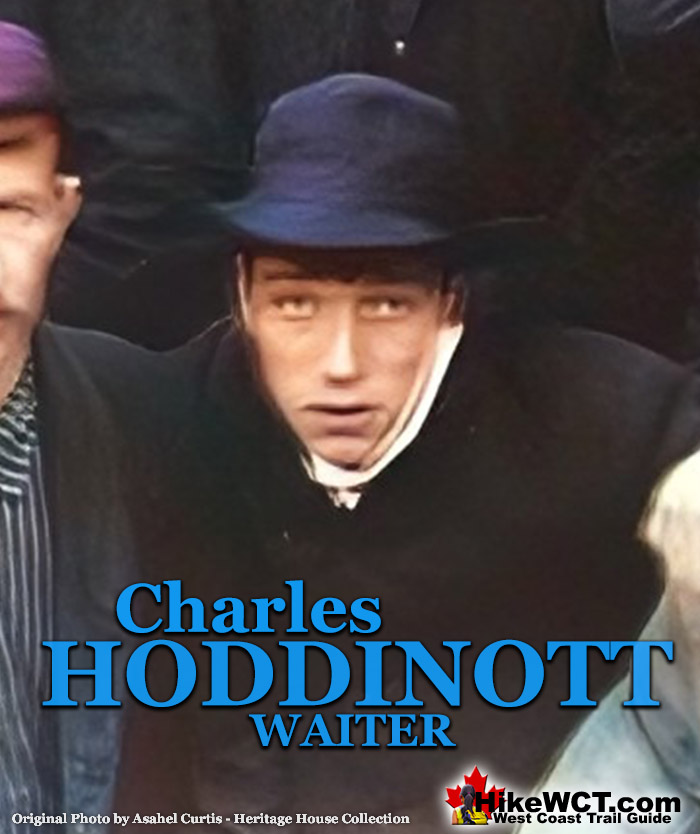
 Charles Hoddinott Valencia Survivor
The Valencia Disaster
 1. The Valencia 2. The Voyage 3. The Boats 4. The McCarthy Boat 5. The Bunker Party 6. On the Valencia 7. The Rafts 8. The Turret Raft 9. The Rescue Ships 10. The Aftermath 11. The Survivors 12. The Lost
The West Coast Trail
Prologue 1: The West Coast Trail 2: When to Hike & Fees 3: Trailheads 4: Getting There 5: Considerations 6: Campsites 7: Shipwrecks 8: Routes 9: Sights & Highlights
Charles Hoddinott Valencia Survivor
Charles P. Hoddinott, a waiter on board the Valencia, and a brother of Chief Steward Hoddinott, J.E. who was drowned. Hoddinott’s brother refused to leave the ship for a place on the last life raft, but urged the witness to go. “I asked my brother to go with me,” said the witness, “but he refused, saying he was going to stand by the women and children. So I bade him good bye and jumped overboard.” – 2 Feb Vic Daily Times. Daily Colonist 13 Feb p6: Hoddinott testified that the weather was exceedingly clear when the boatswain’s crew in No.5 boat left on Tuesday. The Lyall gun was fired before the boat left and the line was ashore. When the Queen came in sight the gun had been fired three times and he thought they were loud enough for the report to carry to the Queen. In his opinion the Czar came within a quarter of a mile but he could not say if those on the tug saw the people on the wreck.
Daily Colonist 13 Feb p6: Hoddinott testified that when the Queen came in sight the gun had been fired three times and he thought they were loud enough for the report to carry to the Queen. In his opinion the Czar came within a quarter of a mile but he could not say if those on the tug saw the people on the wreck. Hoddinott testified that there were 13 members of the crew on the raft and 5 passengers. Launching of the raft took 45 minutes. When picked up by the Topeka they informed the Topeka’s captain that there was another raft out at sea and also passengers on the Valencia. Hoddinott recalled that when he left the ship on the last raft and saw the captain and chief steward go among the woman and ask if they would go on the raft. None expressed any desire to take the chance, evidently thinking that they would be rescued by the ships in the offing. He remembered seeing Miss Van Wyck in the rigging and also Walter Jesse who was continually busy and cheering the passengers. He mentioned an incident of a lady expressing fear of her husband leaving her side and the man in order to set her mind at rest had taken a scarf and tied himself to her by the wrist. When the Queen, Salvor and Czar came in sight he thought that it would be a matter of only a short time before all were rescued. He thought the Czar might have come within 200 yards of the ship at the outside and drifted a raft down the vessel. He thought if the launching of the boats had been deferred until Tuesday some of them would have got safely away. He did not think the shore was more than 100 yards from the stern of the ship.