
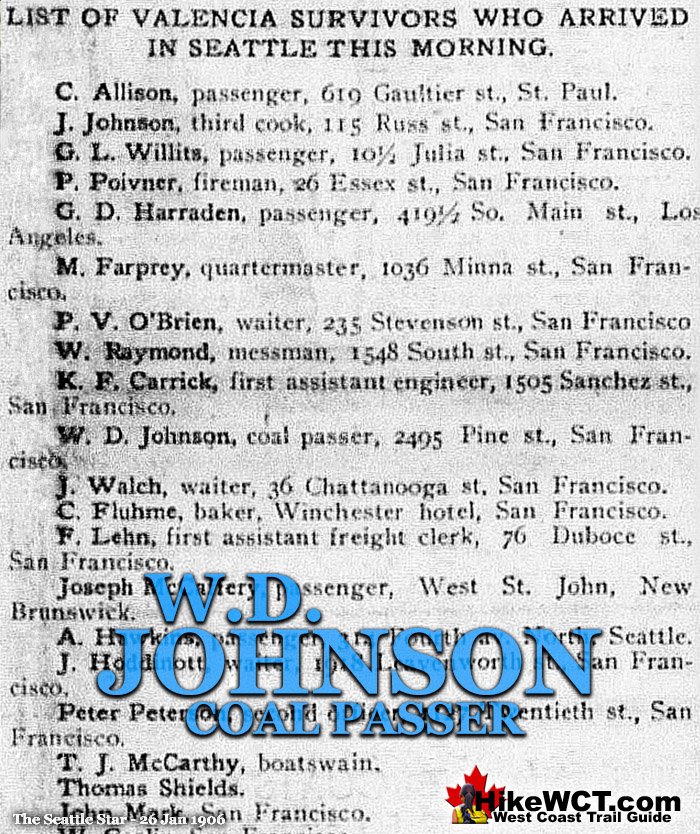
W.D. Johnson was a coal passer on the Valencia who survived on the Topeka Raft. Little is known about him beyond newspaper reports of him being one of the survivors picked up by the City of Topeka. Newspaper reports also list him as one of the survivors that arrived in Seattle.
The Valencia Disaster
1. The Valencia
2. The Voyage
3. The Boats
4. The McCarthy Boat
5. The Bunker Party
6. On the Valencia
7. The Rafts
8. The Turret Raft
9. The Rescue Ships
10. The Aftermath
11. The Survivors
12. The Lost
The West Coast Trail
Prologue
1: The West Coast Trail
2: When to Hike & Fees
3: Trailheads
4: Getting There
5: Considerations
6: Campsites
7: Shipwrecks
8: Routes
9: Sights & Highlights
Conditions on the Topeka Raft were nightmarish. Thomas Carrick first assistant engineer described the survivors standing waist-deep in freezing water, battered by waves, and unable to use the oars effectively. The men improvised, using oars as paddles while forming human “row-locks” to brace each other. Passenger Cornelius Allison recalled, “The water was so cold our limbs became numb. Huge seas buried us, and we choked on saltwater while trying to breathe.” After hours of exposure, some men began to lose their sanity, “blubbering” or “frothing at the mouth,” as Carrick described. McCaffrey observed, “If we had been on that raft an hour longer, every man would have gone insane.”
Thomas Carrick Described their Departure
Thomas Carrick described the departure of the raft: “When we put off from the ship on the raft I called to my oilers in the rigging to come with us, but they refused. All the forward part of the vessel was under water at this time.” On the Valencia all the passengers crowded to the rail and wished them Godspeed and Thomas Carrick recalled the last words Captain Johnson said to him, “Goodbye Tom. For God’s sake try to save your passengers and crew.” The raft was packed with at least twenty men and set off about twenty minutes after the first. It is unknown how many men boarded the raft in the hectic moments where they were jumping off the ship and piling on board. It appears that at least one man was on the raft as it departed, but then disappeared when they hit the breakers. It is possible others fell of and drowned as well. What is known for sure is that nineteen were on board after they cleared the breakers and rowed into the open ocean.
The battered raft headed out to sea toward the rescue ship, the Queen in the distance. To their horror the Queen sailed away. When they lost sight of it they turned toward the land. Freezing and constantly wet they were tossed by the waves and two hours later, close to dead from exposure, they sighted another ship, the Topeka and were finally rescued. Carrick remembered the moment the City of Topeka was sighted. "An incoherent shout from one of the passengers drew our attention and following his pointed finger we saw what afterwards proved to be the Topeka.” Freight clerk Frank Lehn recalled the excitement at that moment. “How we did work at the oars; every man strained at them for his life. The cold waves washing over us and the sleet beating on our heads was forgotten. Nearer and nearer we came to her and we shouted with all our strength, but as the wind was against us we could not make ourselves heard. The steamer was stopped and let drift with wind and current. Suddenly she started and turned out to sea. We almost gave up. If she had gone away, we would have died right there. But she came nearer us every moment. We had one of the men standing in the centre waving a boat hook with a shirt on it. At last their whistle blew as a token that they had seen us. How we shouted for joy. But by that time we could hardly move. The cold went through us and the rain seemed to pierce our very marrow. Finally, the steamer put out a boat, and when they at last made fast a rope and started to tow us to safety, I think I must have collapsed like everybody else on the raft.”
Close to Death Before Rescue
Carrick also remembered how desperately close to death they were. “It seemed as though her arrival was a merciful messenger from God. In a few minutes she was alongside, but some of the men lay inert and powerless to grasp lines cast from the Topeka. Finally, all were hauled aboard and every attention was shown us by the rescue party. If the Topeka had not arrived when she did we would probably have been lost, all of us were rapidly succumbing to the intense cold.” The nineteen men picked up by the second raft, which became known as the Topeka Raft were: passenger Cornelius Allison, first assistant engineer Tom Carrick, fireman William Doherty, baker Charles Fluhme, passenger George Harraden, passenger A.H. Hawkins, waiter Charles Hoddinott, third cook John Johnson, coal passer W.D. Johnson, first assistant freight clerk Frank Lehn, passenger Joseph McCaffrey, waiter Patrick O’Brien, second officer Peter Peterson, fireman Paul Primer, messman Walter Raymond, quartermaster Martin Tarpey, waiter John Walsh, passenger Grant L. Willitts and fireman John Segalos.
Valencia Second Life Raft January 24th, 1906

The barely alive men on the raft had no way of knowing that the Valencia crumbled into the sea about one hour ago, killing all the remaining survivors. They wouldn’t hear that news for a couple more hours. When they asked about the first raft, they were dumbfounded to hear it must still be out there. They barely survived three hours of hell on the second raft, the first raft, later called the Turret Raft was still going through hell. A horrific journey considerably more brutal and lasting 26 hours. When the Topeka Raft was getting rescued, the nightmare on the Turret Raft was just beginning.
