
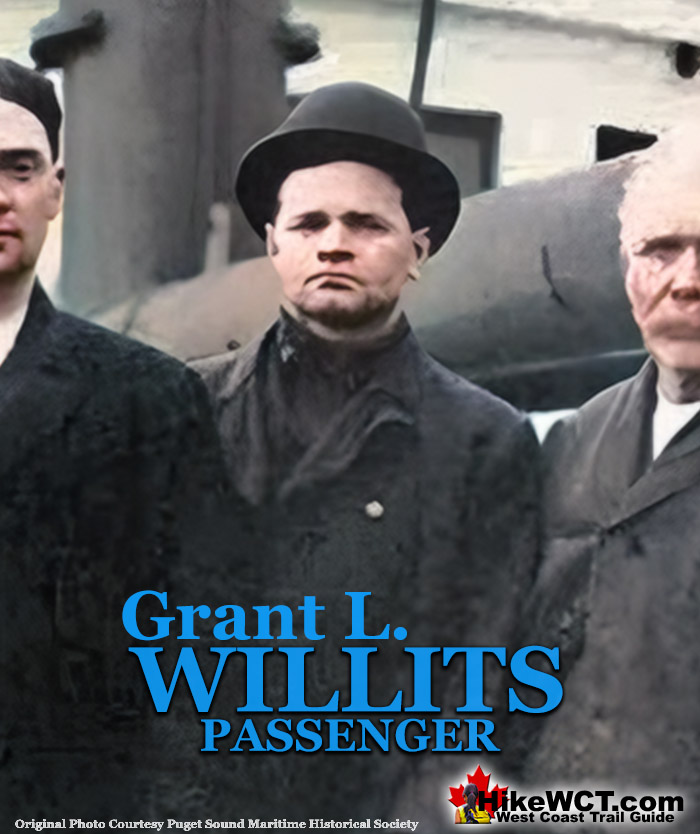
The Valencia Shipwreck on the West Coast TrailGrant L. Willitts, sometimes spelled Willits or Willets, was a second-class passenger aboard the ill-fated SS Valencia, who survived on the second raft (Topeka Raft), the last raft to depart the Valencia. A skilled lather (construction framer) from Riverside, California, approximately 50 miles southeast of Los Angeles, Willitts was traveling to Seattle in search of work, with plans to settle there with his wife if successful.

Grant L. Willitts

Early reports on Valencia survivors often confused Wittitts with another survivor named Albert Willis, another survivor due to their similar names. To add to the confusion, the Valencia’s passenger list printed in newspapers listed him as J. Willits. Photos of Willitts appeared in various newspapers and by far the best one was printed in the San Francisco Examiner on January 29, 1906. The Puget Sound Maritime Historical Museum Society has a nicer version of it. The photo shown here is a colorized version of it. It is a photo of the five Valencia passengers that were rescued by the City of Topeka. They were A.H. Hawkins, Joseph McCaffrey, Grant L. Willitts, Cornelius Allison and George Harraden.

Grant L. Willitts was interviewed after the disaster and his recollection of the events on the Valencia are terrifyingly vivid. His story appeared in dozens of newspapers after he was rescued. He recalled the moments after the Valencia first struck at 11:50pm Monday, January 22nd:

"I was on deck at the time smoking a cigar, and was looking at my watch when the first crash came.  In an instant all was excitement.  There were the shrieks of the frightened men and women, the wail of little children and the hoarse orders of the officers of the ship.  The vessel reeled like a drunken man, slid over the reef and struck again.”

The Valencia had collided with a rock or ledge a few hundred yards offshore where she hung for a few minutes as the vessel pivoted at a right angle from the shore, bow facing out to sea. Taking on water and sinking fast, Captain Johnson orders engines full reverse hoping to beach on the shore.  The ship backed onto a reef, bow facing out and stern 20 metres from the cliff which formed the shoreline.

 “The command to back her off was given and she went astern at full speed but it was too late.  The water was pouring in like a mill race.  The wind swung the vessel’s stern to the beach and her head to the waves.  This saved many lives, as she was then swept back to the shore, and struck once again in such a position that she remained partially above the water and on an even keel.  Every wave washed clear over her and many people who hastily rushed on deck went to their death without time to murmur a prayer. "

The Valencia had seven lifeboats and three life rafts. In the first hour three of the boats were smashed to pieces against the ship, killing all but one on board. Another two boats managed to get away from the ship, then flipped and smashed against to pieces against the reef, killing most of the passengers. One boat disappeared into the night and never seen again. One of the three life rafts was lost. Willitts described the chaos from midnight to about 12:30am when six of the Valencia’s lifeboats were launched:

"The order was given to get out the boats.  Two of them on the weather side were launched and were smashed like eggshells as soon as they struck the water.  Then came the attempt to get out the lee boats."

"Purser O’Farrell took charge; four women and a number of men went into the boat.  I do not know how many, but she was practically full.  Just as they were lowering the other the davits broke, and the stern of the boat fell to the water while the bow hung in the air.  Everyone was precipitated into the sea and swept away in an instant.  For a second or two I caught a glimpse of an agonized face then another, and yet another, as they were washed by me."

Valencia Wrecked Along the Terrifying West Coast

Valencia Map Brutal Coast

7:30am Tuesday 23 Jan: The Morning After

The people aboard the Valencia could barely make out the shore in the darkness and wouldn’t find out until morning that the cliffs along the shore were vertical and about 100 feet tall.  To add to the confusion, all on board assumed that they were located along the coast of Washington State, south of Cape Flattery.  Their actual location was along the mostly uninhabited west coast of Vancouver Island. The terrain along the coast is steep, crisscrossed with creeks and rivers, and covered in such dense vegetation as to often be characterized as impenetrable.  The cold, rainy weather also added to their misery and the coast was blanketed with a few centimetres of snow. Willitts described the next few hours on the Valencia:

"The waves dashing over the ship swept the deck loose and every swell lifted it.  We clung to the rigging of the deck house... The ship struck in a bad spot.  She was directly at the foot of a precipitous bluff that comes sheer to the water’s edge. One man was swept ashore, and succeeded in landing on a small rock.  We shot a line to him and he tried to climb the cliff, but fell and was killed before our eyes."

"One of the Most Pitiable Incidents"

Willitts recalled some of what he saw on the Valencia on Tuesday, January 23rd:

"One of the most pitiable incidents was that of a little boy of about five years old.  His father, mother and two little sisters put off in one of the boats.  The boat capsized and all were drowned.  The little fellow walked around the deck crying for his mother.  The last I saw of him he was clinging to the rigging."

Who this little boy was is a bit of a mystery, though Sam Hancock, who survived on the Turret Raft reported who he remembered on the ship.  He mentions Mr. and Mrs. Ogle, with four children.  When he left the parents and their children were gone, but one little boy was still aboard. William Ogle and his wife were on the Valencia with their four children, two young sons, one daughter and a baby. Fragments of what some Valencia survivors mention indicate that Mr. and Mrs. Ogle and three children drowned during the first hour after the ship struck. They were on one of the lifeboats that crashed into the ocean when ropes were cut and slammed against the side of the ship. Three of the four Ogle children's bodies were later recovered and one of them likely was the little boy that Willitts and Hancock remembered. Two of the children, Carl and Neita Ogle, were identified were buried together. The third body was recovered several days later. Described as the oldest of the Ogle children, he was buried next to Carl and Neita.

Message in a Bottle

Roy Hazard, Mabel & Lulu RowlandWillitt’s also recalled, “A lame officer from the Concord accompanied by his two sisters was also in the rigging.” These three were unidentified and their description doesn’t correlate with any registered passengers. Their description does match a trio of runaways on the Valencia with fake names and are known to have been still alive on the Valencia. Their extraordinary story was revealed in the days after the wreck and months after the disaster when a message was found in a bottle on a beach 800 kilometres away on the distant island of Haida Gwaii. This bottle contained a letter written in pencil and difficult to read, which was sent from the Valencia during a moment of hopeless desperation.  “We are going down off the coast. – C.F. Hayward.”  No one by that name appeared on the ships manifest, however in the weeks following the disaster it was discovered that three of the passengers were registered with fake names. The passenger listed as C. West was actually Roy Hazard, 21 years old, from Los Angeles, California who had run away with two passengers listed as Miss T. Martin and T. Simpson. Also registered under fake names, they were in fact Mabel Rowland, 18 years old, and Lulu Rowland, 16, from Los Angeles.

"We Could See Them Dashed Against the Sharp Rocks"

By 9:30am Wednesday morning, more than 33 hours since the Valencia first wrecked,  the ship was rapidly going to pieces. Battered by waves, the ship was breaking apart and sinking lower into the crashing ocean.  About 100 people remained clinging to the few upper parts of the ship still above water. Willitts described in vivid detail what he remembered:

"Every swell carried away a portion of the ship, and the decks rose and fell with every breaker, and it was impossible to stay on deck without clinging to a support.  The ship was sunk to about the level of the hurricane deck.  In the morning another sad calamity occurred.  About fifteen or twenty persons, amongst them one or two women, and taken refuge in the foretopmast.  They appeared to be in the safest place, as it was removed from the wash of the waves, although the flying spray dashed over their heads.  Suddenly and without warning the mast tottered and fell with a crash, carrying its load of shrieking human freight to a terrible death.  I do not think a single one was saved.  Their bodies were washed from the ship and we could see them dashed against the rocks."

"To add to our misery, the last of our food was washed away and we had not water to drink.  The wind and rain combined with the sea soon numbed us.  Every time one of those in the rigging would lose his hold he would be swept away to the sharp rocks."

Rescue Ships Arrive

Finally the nightmare for the remaining survivors on the Valencia was about to end, rescue was finally coming.  The ship they saw was the Queen, a similar ship to the Valencia and owned by the same company.  Minute after agonizing minute as the Valencia shuddered and continued to fall apart as the ocean swells pounded it, their hopes faded.  Soon another two smaller ships arrived and despite the stormy seas came closer, then quickly retreated.  On the Valencia they waved and did everything they could to be seen. The decision was made to launch the two remaining life rafts. Willitts recalled:

"When we saw the Queen in the morning we thanked God for saving us… When the Queen was first sighted the women in the rigging even removed portions of their clothing to wave as a signal for help from their positions in the rigging."

Valencia Drawing from Description by Willitts

This drawing appeared in the January 28, 1906 edition of the Seattle Post Intelligencer. Based on the description given by Grant Willitts of the wreck of the Valencia when he departed on the last life raft which was rescued by the City of Topeka three hours later. The Valencia crumbled into the sea about 1.5 hours after Willitts and the others departed. They left about 80 survivors on the disintegrating ship. They all drowned when the Valencia crumbled into the sea.

10am-1030am Wed 24 Jan Both Rafts Launched

At about 10am and 10:30am Wednesday morning the two rafts were launched toward the rescue ship, the Queen which lay less than 2 miles out to sea. This was a desperate attempt that didn’t seem likely to succeed.  First, the rafts are low in the water and the passengers would be partly immersed in the freezing ocean. Second they are hard to maneuver and rowing past the breakers crashing all around them seemed unlikely.  Incredibly the first raft, manned by only ten men, as nobody else would get aboard, made it through the breakers relatively easily. After the first raft departed, the second life raft was readied and boarded more enthusiastically by nineteen men. Willitts recalled:

Few of the men cared to make the attempt, as it appeared to be certain death to try to cross the breakers... With only a bit of oars the struggle against the wind and sea was almost too much for us. Part of the time we were under water and were almost drowned. But we impelled by desperation and fought and fought against the elements like demons... but when she, in company with the tug, sheered off and sailed away, she was followed by nothing but curses. I suppose it was too dangerous for them to attempt to save us.

Only Valencia's First Life Raft Was Recovered

Valencia Liferaft (Turret Raft) Recovered

Conditions on the Crowded Second Raft

Thomas Carrick, first assistant engineer on the Valencia, remembered the terrible conditions on the crowded raft in the first hour:

Valencia Survivor Thomas Carrick

"We had a fearful struggle getting clear of the breakers.  We were about 300 yards from shore.  So many were on the raft that we all stood waist deep in the chilling water.  The breakers roared and crashed over us.  We worked our way seaward as the Queen came on.  The oars had previously been lashed to the raft, but were useless under water.  We cut them loose and two men were placed face to face, the oar placed between them, thus forming a human row-lock.  These two men were braced by others pushing against their backs and sitting on their feet.  I was on the stern of the over-freighted raft, attempting to steer.  Buffeted and tossed about by the unrelenting sea, we continued toward the Queen.  Hope was high, and everyone worked and shouted with might and main.  The Queen rapidly drew away from us and finally disappeared from view.  Most of the passengers were crushed with despair."

Agonizing Hours on the Raft

Valencia Survivor Joseph McCaffrey

Carrick and others continued to describe the scene on the raft after the Queen departed and two hours after setting off from the Valencia: “Some of the men began blubbering and many were frothing at the mouth.  It seemed that many were losing their minds."  Valencia passenger Joseph McCaffrey recalled, "There were two or three men on the raft who kept up the spirit of their companions by cheering them on and holding out every hope of rescue within a short time."  McCaffrey goes on to describe, as Carrick did, how the men were being driven insane by the conditions on the raft.  Freezing cold, drenched in seawater and likely no hope of finding another ship.  "If we had been an hour longer on that raft I believe every man would have gone insane."  He could tell by the looks in the eyes of his companions that, "reason was departing.  Just touch some of the men and they would growl like some trapped animal.

12:10pm Wed 24 Jan: The City of Topeka Sighted

Carrick remembered the moment the City of Topeka was sighted just after noon on Wednesday, January 24th.  "An incoherent shout from one of the passengers drew our attention and following his pointed finger we saw what afterwards proved to be the Topeka.”  Freight clerk Frank Lehn recalled the excitement at that moment:

“How we did work at the oars; every man strained at them for his life.  The cold waves washing over us and the sleet beating on our heads was forgotten.  Nearer and nearer we came to her and we shouted with all our strength, but as the wind was against us we could not make ourselves heard.  The steamer was stopped and let drift with wind and current.  Suddenly she started and turned out to sea.   We almost gave up.  If she had gone away, we would have died right there.  But she came nearer us every moment.  We had one of the men standing in the centre waving a boat hook with a shirt on it.  At last their whistle blew as a token that they had seen us.  How we shouted for joy.  But by that time we could hardly move.  The cold went through us and the rain seemed to pierce our very marrow.  Finally, the steamer put out a boat, and when they at last made fast a rope and started to tow us to safety, I think I must have collapsed like everybody else on the raft.”

Willetts briefly described how desperate they were and close to death when finally sighted by the Topeka:

We held one man upright in the center of the raft and had him wave a shirt on a pole. When we saw the steamer turn we thought she had overlooked us and was going away. If she had we would have died right there... The waving of the shirt on the raft reminds me that when the Queen was first sighted the women in the rigging even removed portions of their clothes to wave as a signal for help from their position in the rigging.

Topeka Crew & Valencia Survivors January 24th, 1906

Valencia's Second Raft Rescued

Rescue of Valencia's Second Life Raft

Second Valencia Raft 19 Survivors

The Nineteen Topeka Raft Survivors

The Valencia survivors with Grant L. Willitts on the second life raft, which became known as the Topeka Raft were: waiter Charles Hoddinott, baker Charles Fluhme, passenger Cornelius Allison, first assistant engineer Thomas Carrick, fireman William Doherty, passenger George Harraden, passenger A.H. Hawkins, third cook John Johnson, coal passer W.D. Johnson, first assistant freight clerk Frank Lehn, passenger Joseph McCaffrey, waiter Patrick O’Brien, second officer Peter Peterson, fireman Paul Primer, messman Walter Raymond, quartermaster Martin Tarpey, waiter James Walsh, and fireman John Segalos.

The Five Passenger Survivors on the Topeka Raft 

Passenger Survivors from the Topeka Raft

This amazing photo of Willitts and the four other passenger survivors was taken on January 25th or 26th, after the rescue and before they arrived in Seattle. These were the five Valencia passengers that were on the Topeka Raft. A.H. Hawkins, Joseph McCaffrey, Grant L. Willitts, Cornelius Allison and George Harraden.

Twelve of the Valencia's Crew Survivors

Valencia Crew Survivors

Topeka Raft Survivors in Seattle

Willitts also appeared in this photo of Topeka Raft survivors on the cover of the Seattle Star newspaper on January 26th, 1906. The survivors shown are, second officer Peter Peterson, passenger Grant L. Willitts, first assistant engineer Thomas Carrick, passenger George Harraden, passenger A.H. Hawkins and passenger Cornelius Allison. The photo was taken in Seattle shortly after arriving on the City of Topeka.  The newspaper reported, "All were in an emaciated and tattered condition when reaching port.  They had saved nothing but the clothes upon their backs, and this, with many of them, was reduced to rags.  A few had a little money in their pockets; the majority little or nothing.  In the hours aboard the stricken Valencia, when grim death lurked so near.  It was not money or personal effects that the people thought of.  It was life, so sweet and dear when it seemed so certain of being lost, and consequently these survivors came to the city broken in spirit and badly off for means of sustenance."  The Pacific Coast company, the owners of the Valencia provided the men everything they desired and taken to clothing stores, restaurants and given rooms at the Rainier Grand.  The men living in San Francisco were given tickets to get them back home.  The Pacific Coast has, "opened its purse with an unstinted hand to overcome as far as possible the inconveniences thrust upon the survivors through the disaster." 

Topeka Raft Survivors - Seattle Star 26 Jan 1906

Grant L. Willitts After the Rescue

The January 26, 1906, edition of the San Francisco Chronicle captured the emotional reaction of Mrs. Willitts when she learned he survived:

“Mrs. G.L. Willitts, after having suffered complete prostration as a result of a bulletin announcing the death of her husband, received the welcome news of his rescue with tears of thanksgiving… He is an expert lather and is highly thought of by all the neighbors around his home, at 14 Julia Street.”