
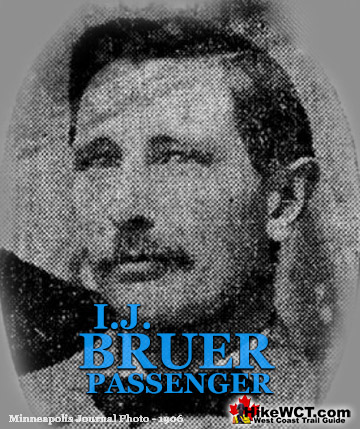
I.J. Bruer - Passenger
Ingwer J. Bruer, known as I.J. Bruer, a 48-year-old lumber businessman from Minneapolis, Minnesota, perished in the SS Valencia maritime disaster of January 22–24, 1906. The coastal passenger steamer ran aground in heavy fog off the rugged west coast of Vancouver Island, British Columbia, and broke apart in pounding surf. I.J. Bruer’s name did not appear on the official passenger list, but he was confirmed to have boarded the vessel. His body was later recovered and identified through dental records after his niece traveled to Victoria offering a reward. Ingwer J. Bruer was born in June 1857 near Hamburg, Germany. He came to the United States as a boy with his parents. Before settling in Minneapolis, he lived in Los Angeles with his family for two years and earlier operated a lumber business in Bancroft, Iowa.
For the past five years, he had been a partner in the prosperous Bruer Brothers lumber yard and mill at 2840 Lyndale Avenue South in Minneapolis. He was at the head of the company, and his two elder sons, Harry and Franz, worked with him in the business. He also had a younger son, Leo, and a wife. The family resided at 2621 Garfield Avenue in Minneapolis.
On January 2, 1906, I.J. Bruer left Minneapolis for a pleasure trip along the Pacific Coast, planning to stay until the harsh winter passed. He had many friends on the coast from his time in Los Angeles. On the evening before the Valencia sailed, he visited his friend Albert Meyers in San Francisco. Two hours before boarding, he wrote a letter stating he was traveling on the steamer. This letter, forwarded by Meyers, was the first confirmation his family received that he was aboard.
The Valencia Disaster
The Valencia departed San Francisco on January 20, 1906. It struck the rocks late on the night of January 22 in heavy fog. In the days immediately following the wreck, Bruer’s family remained hopeful. Contemporary reports in the Minneapolis Journal (January 25, 1906) noted that he was an experienced traveler, vigorous, and cool-headed, with no one but himself to look after. They believed that if the usual custom of “women and children first” was followed, the men would have been among those left for later boats or rafts, and early reports suggested some were still alive on the wreck.
Photo of I.J. Bruer - Minneapolis Journal 25 Jan 1906

Recovery, Identification, and Family Efforts
Bruer’s body was among those recovered in the days after the disaster. On January 29, 1906, the Victoria Daily Times reported that his niece, Miss Minna Bruer of Minneapolis, had arrived in Victoria seeking information about her uncle. His name was absent from the passenger list, but she offered a $100 reward for the recovery of his body.
The following day, when the tug Wyadda brought several bodies to Victoria, one was identified as I.J. Bruer—confirmed through dental records due to the condition of the remains. His niece helped with the identification.
I.J. Bruer’s body was eventually returned to Minneapolis and interred at Lakewood Cemetery (Section 17, Lot 194, Grave 3; Find a Grave Memorial ID 141404790).
His death cast a heavy gloom over his family and the Minneapolis business community. Early hopes that he might have survived were replaced by grief, compounded by the challenges of confirming identities amid the chaos following the wreck.