
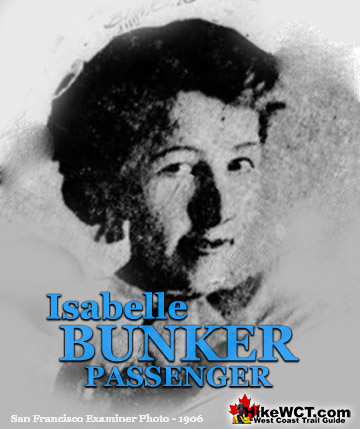
Isabelle Bunker
Isabelle Bunker, Frank Bunker, their 4 year old daughter Dorothy and 2 year old son Frank were on the No.6 lifeboat that departed the Valencia during the first hour of the disaster. In middle of the night, in stormy weather and freezing rain, boat No.6 managed to get a couple hundred yards from the Valencia before being caught by a breaker and casting most on board into the freezing ocean. Frank Bunker, his wife and son managed to survive, though Dorothy was never seen again. Moments later the boat, caught in another breaker was thrown again. This time the boat smashed into the reef. Frank Bunker managed to survive by crawling out of the surf and clinging to the base of a cliff. The rest of his family were never found. Frank Bunker went on the lead quite a prominent role in the Valencia tragedy. After being washed ashore at the base of a cliff he gathered with eight others and was the driving force of the group that made their way to a telegraph hut and notified the world of the shipwreck of the Valencia. The article pictured here with the title "BUNKER SAVED BUT WIFE AND TWO CHILDREN LOST" appeared in the San Francisco Call newspaper on January 25, 1906.
The 24th of January edition of The San Francisco Call newspaper wrote: “The Bunker family were moving from Berkeley California to Seattle, where Frank Bunker was to soon begin working as Assistant Superintendent of Schools. Mrs. Bunker was formerly a Miss Bull of Tulare, and the two were married six years ago. Two children were born to the couple – Dorothy, a pretty girl of 4, and Frank, aged 2. The Bunker family had planned to make their home in the north, his position with the school department of Washington being a lucrative one; but the sea disaster put an end to a happy outlook. Bunker was formerly vice principal of the San Francisco Normal School and is very well known in this city. The family lived for some time on Baker Street, opposite the park panhandle. Later he took up his residence in Berkeley. Mrs. Bunker was a young woman and was very well known to the residents of Tulare, where she was born. Bunker is a native of Los Angeles, having received his early education there. He advanced rapidly in educational work.”