
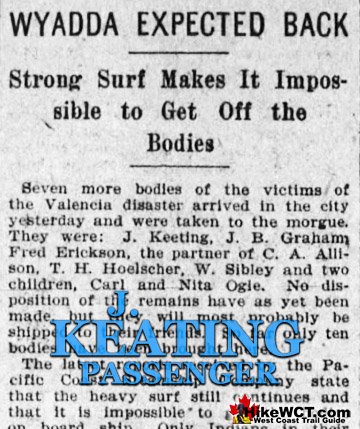
James Keating - Passenger
James Keating was a second-class passenger on the Valencia. He was 38 years old and worked as a lineman for the Postal Telegraph Company in San Francisco. His body was found and eventually identified after a tremendous amount of confusion. Like many victims of the wreck, his story became entangled in a web of mistaken identities and anxious family inquiries that played out in newspapers across the West Coast in the weeks following the tragedy.
A Body Identified — and Then Questioned
One of the first bodies recovered was brought to Seattle on the tug Bahada shortly before noon on February 1, 1906. It was found near Turret Island and quickly became the center of confusion.
The Seattle Post-Intelligencer reported that the body had been identified as both James Keating, a former Dawson baseball player, and as W. Wilson, a second-class passenger en route to Seattle.
Chief Cook Hancock, a survivor from the Valencia, insisted the body was that of Wilson. He recalled that Wilson had been on the same life raft with him — one of the first to leave the wreck. Five men on that raft became insane from exposure; Wilson reportedly leaped into the sea, believing he was near an island. A handkerchief found on the body with the initial “W” embroidered in red silk seemed to confirm Hancock’s account.
Yet William Bates, a professional athlete from Dawson and a personal friend of Keating, viewed the remains at the Bonney-Watson morgue and immediately identified them as his friend. Bates noted that Keating had played on the Dawson baseball team the previous season, was well-known in Seattle from prior visits, and had a brother in Nome and relatives in Michigan.
The newspaper coverage at the time leaned toward the body being W. Wilson, but the conflicting positive identifications highlighted the challenges of identifying victims in the chaotic aftermath of the wreck.
Separate Bodies, Lingering Confusion
Just days later, on February 4, 1906, seven more bodies arrived in Seattle, including one listed as “J. Keeting” (a common spelling variation). This appeared to be a different individual from the earlier Turret Island body. On February 8, the Post-Intelligencer published a simple death notice:
“KEATING—At Cape Beale, January 23, 1906. James Keating, aged 38 years.”
Meanwhile, families across the region were desperately searching for loved ones whose names appeared on passenger lists. In Sacramento, John Keating feared that “J. Keating” on the list might be his brother, who had last been heard from while traveling between Seattle and the East Coast.
In San Francisco, two sisters — Miss Madge Keating of 2718 California Street and Mrs. R. Haley of Sacramento — agonized over whether the victim was their 19-year-old brother, James William Keating, who had recently moved from Minneapolis and was planning to go to Seattle. On February 16, 1906, the San Francisco Examiner published their plea, noting that the young man always signed his name “J. W. Keating,” never “Jim.” Madge expressed desperate hope that he would contact them once he learned of their worry.
The very next day, February 17, the same newspaper offered relief. D. J. Gorman of 3279 Sixteenth Street came forward to clarify that the Keating lost on the Valencia was not the young James William Keating. Gorman stated that the deceased had worked as a lineman for the Postal Telegraph Company and was at least thirty years old — matching the 38-year-old James Keating who had been employed in San Francisco.

Final Resting Place
James Keating’s body was eventually laid to rest at Lake View Cemetery in Seattle. His gravesite records his age as 38 and notes that he drowned near Cape Beale, British Columbia, on January 23, 1906.