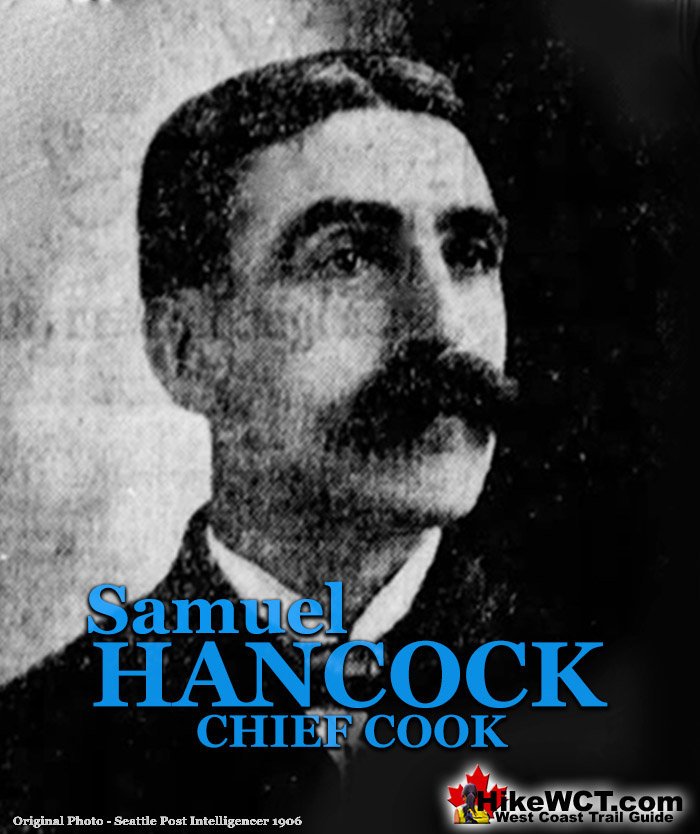
Sam Hancock was the chief cook on the Valencia and survived on the life raft that travelled 37 kilometres before finally landing at Turret Island. Later dubbed the Turret Raft, Hancock was just one of four survivors out of the ten men that set off from the first of two rafts that left the Valencia just two hours before it collapsed into the sea.
The Valencia Disaster
1. The Valencia
2. The Voyage
3. The Boats
4. The McCarthy Boat
5. The Bunker Party
6. On the Valencia
7. The Rafts
8. The Turret Raft
9. The Rescue Ships
10. The Aftermath
11. The Survivors
12. The Lost
The West Coast Trail
Prologue
1: The West Coast Trail
2: When to Hike & Fees
3: Trailheads
4: Getting There
5: Considerations
6: Campsites
7: Shipwrecks
8: Routes
9: Sights & Highlights
Hancock was a resident of San Francisco and had been a sea cook for twenty years. He had been in three shipwrecks before the Valencia. He was aboard the George W. Elder when she went aground and was wrecked in the Columbia River. He Was also on the steamer Oregon when she was burned at sea, and on the St. Paul when she went ashore on the coast of California. The Seattle Post Intelligencer interviewed Hancock when he reached Seattle after the Valencia disaster and he described the ordeal on the life raft:
Of the ten men who left the Valencia on the life raft, one died from exposure less than two hours after the raft left the ship, and five others went violently insane before reaching Turret Island. Twenty-nine hours without food or water, a part of the time washed by the waves which swept over the life raft and pierced by the cold wind and icy sleet, the sufferings of the four men who survived the awful hardships were beyond description.
Chief Cook Hancock jumped from the Valencia into the boiling sea to reach the raft and take command after it had been launched and was about to leave the ship. He took the steering oar, and working with the current, guided the life raft to the north for hours until he saw the opportunity to ground the little craft in a cove on Turret Island.
Only by sheer grit was he able to cling to the steering oar. One by one he saw the others driven mad and dashed from the life raft into the sea until only four were left on the little craft with him. At times he was so numbed by the cold and exposure that he was ready to drop; then, strengthened by the desperate plight of the little handful of men, he would recover and renew his efforts to save himself and the others.
Photos of Sam Hancock & the Turret Raft

Photos of Sam Hancock and the Turret Raft. From left to right: Sam Hancock - Seattle Post Intelligencer 29 Jan 1906. The second photo appeared in the Victoria Daily Times on 29 Jan 1906 and shows Sam Hancock boarding the Salvor at 9am Friday, Jan 26th soon after they were found. The next picture appeared in the Victoria Daily Times on 29 Jan 1906 and shows the Turret Raft when it was found at 1pm on Friday, Jan 26th. The bodies of Harvey Gnegy, Robert Nelson and John Wallace were found on the raft. The last picture on the far right shows the Turret Raft in Seattle after it was recovered.
10am Wed 24th Jan: Leaving the Valencia
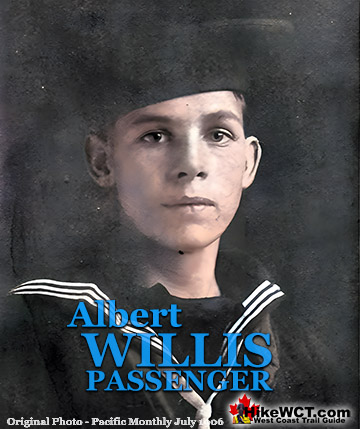
The first raft which Hancock was on left with only ten men at somewhere between 9:30am-10am. In charge of the raft was third assistant engineer Robert Nelson. Also on board were, waiter Frank Connors, fireman Max Stensler, fireman George Long, waiter John Wallace, passenger Adam Rolph, passenger W. Wilson, and two passengers on leave from the US Navy, Harvey Gnegy and another man name unknown.

Hancock later recalled:
About 9am Wednesday morning a big wave broke over the ship. It was then concluded to launch the life rafts which were all ready. Finding we were on the point of sinking the chief officer came to him to organize a party to man the rafts. Most all declined to go, even his 2nd and 3rd men and chief baker, none of the engineers but Nelson came.
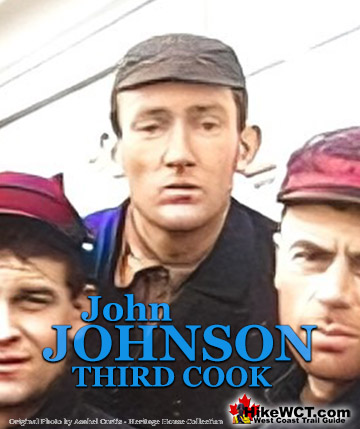
The three men Hancock refers to as his 2nd, 3rd men and chief baker were second cook James Cameron, third cook John Johnson and baker Charles Fluhme. James Cameron would not survive when the Valencia finally collapsed into the sea about two hours after Hancock and the others departed on the first life raft. John Johnson and Charles Fluhme survived on the second life raft that departed soon after the first raft and was rescued by the City of Topeka at 1pm, just three hours after it left the Valencia.
Valencia Second Life Raft Rescued 1pm January 24th, 1906

Hancock and the others rowed as best they could toward the Queen, however the current relentlessly dragged them up the coast, away from the Queen. The huge ocean swells and bad weather made them practically invisible to nearby ships even if they were looking for them. Which, incredibly, by about 11am they were not. The Queen had been ordered back to Victoria and was steaming into the distance. The two smaller vessels the Salvor and the Czar, afraid to approach the Valencia as they feared wrecking themselves, departed to Bamfield to send a rescue party by land. Another vessel, the City of Topeka was to relieve the Queen and stay in the vicinity of the Valencia, however a miscommunication caused the Topeka to not find the Valencia.
4pm Wed 24th Jan: First Man Dies of Exposure
The time was now about 4pm, they had been on the raft for six hours and were close to succumbing to the cold. Around this time the US navy man with the unknown name died of exposure. Reporter, R.P. Dunn, who interviewed Hancock hours after being rescued, wrote in the Victoria Daily Times:
“So poignant was the disappointment that one of the passengers, who was of more delicate appearance than the others, and whose vitality was unequal to the mental and physical strain gave up the unequal fight and in a few minutes passed away. The others, knowing that every unnecessary pound of weight on their slight craft reduced their chance of surviving, dropped his body overboard.”
Little is known about this man except that he was in the navy and probably serving on the same ship as fellow passenger Harvey Gnegy. What is known for sure is that they were close friends and Gnegy was opposed to having his friend thrown overboard. He particularly resented Hancock for the incident, which suggests that Hancock directed this action.
5pm Wed 24th Jan: "I saw him dashed against the rocks..."
Still being dragged up the coast by the current and their last hope, Cape Beale Lighthouse fading in the distance, the nine men barely alive on the raft gave up hope. They gave up on rowing and having no idea where they were, they floated aimlessly north. Soon another passenger Adam Rolph, driven mad from the helpless agony of drifting nowhere, jumped overboard and drowned. From his interview with Hancock, R.P. Dunn wrote about what drove Adam Rolph to jump from the raft.
“Who can place himself in such a position and imagine the dreadful strain upon the castaways in their struggle for life, mental and physical, and not acknowledge that the outcome was most natural? Those not inured to the hardships of the sea either sank benumbed with the extreme cold or else became so frenzied with despair as to reach a condition bordering upon insanity. The latter was the fate of a fashionably dressed passenger. He was best with all kinds of illusions. Finally, he swore that there was an island a few feet off and that he could swim the distance easily. Suiting the action to the word he precipitated himself into the sea and was never seen again. Probably the body reported to have been found on an island in the neighbourhood will, when identified, prove to be that poor fellow’s remains.”
Adam Rolph was a passenger on the Valencia heading back to his wife and five children in New Westminster where he lived for twenty years. The Daily Colonist reported that Rolph had recently resigned his position as bookkeeper at the St. Mungo Cannery, Fraser River, and went to San Francisco to engage in a business venture there. Mrs. Rolph received a letter from him that his plans had miscarried and that he was returning on the Valencia. Frank Connors, also on the raft with Rolph, later recalled, “I saw him dashed against the rocks, we were unable to help him.” Rolph's body was found a couple days later, washed ashore not far from where he jumped from the raft.
5pm-6pm Wed 24th Jan: W. Wilson Leaped into the Sea
Probably around 5 or 6pm they drifted into Barkley Sound and the scattering of islands of the Broken Group. Distant islands appeared around them, though they had given up hope and had no strength left to row. Even if they could muster the strength to row, they felt hopeless against the relentless current. At this point the eight remaining survivors on the raft had endured about eight hours of agony, soaking wet with freezing seawater, W. Wilson leaped into the sea and swam toward one of the far away islands. He drowned in the attempt, leaving only seven desperate men on the raft.
11pm Wed 24th Jan: Reach Land After 14 Hours
The current dragged them as they watched helplessly, now in darkness, as distant shadows of islands passed them on either side. There was suddenly renewed hope when they found themselves drifting toward an island. Of the seven men on the raft, three were so close to death they barely moved. The other four, Sam Hancock, Max Stensler, George Long and Frank Connors manned the oars and struggled closer and closer. Probably between 11pm and midnight, Wednesday, January 24th, after fourteen hours of hell they landed on Turret Island. The four men managed to pull the raft above the high water mark and collapsed to the ground exhausted. The other three men, third assistant engineer Robert Nelson, waiter John Wallace and passenger Harvey Gnegy barely moved. Gnegy and Nelson were nearly dead from exposure and Wallace was probably already dead.

12am-5am Thurs 25th Jan: Grnegy Attacks Hancock
At some point during the night, Harvey Gnegy sprang to life apparently possessed with the idea that Hancock was “a wild dog and good to eat.” Gnegy jumped on the sleeping Hancock and began choking him. Hancock and the others woke and overpowered Gnegy who had lost his mind. Apparently the first man on the raft to die, the unknown navy man that the others pushed into the sea was a close friend of Harvey Gnegy. The others would later speculate that this was the cause of the hate directed at Hancock. After the attack, Gnegy shrank back and collapsed. He never moved again.

5am Thurs 25th Jan: Search for Help
In the morning at about 5am, with daylight approaching, Hancock, Stensler, Long and Connors woke. They had no idea where they were, but finally on solid ground they could walk in search for help. They were sure that John Wallace was dead, but believed that Harvey Gnegy and Robert Nelson were still be alive, though barely. They hoped to find help and return to the raft for Gnegy and Nelson when they do. Wandering into the forest they soon lost their way back to the raft and focussed on just moving forward.
9am Thurs 25th Jan: Connors Splits from Group
After a few hours wandering through the forest, they decided it was best to walk along the shoreline as close as possible. It was now about 9am, 23 hours since they left the Valencia, and it seems Frank Connors was beginning to lose his mind. He insisted that in the other direction they would find Cape Beale Lighthouse. The others ridiculed this idea and Connors set off on his own into the forest along. Hancock, Stensler and Long continued along the coast while Connors headed inland and disappeared. Along one stretch of beach the trio found oranges that must have drifted in from the Valencia. The greedily ate them and then searched around for anything else edible. They found some sort of vegetation along the forest and tried digging for clams, but found none.

12pm Thurs 25th Jan: Hancock, Stensler and Long Found
At about noon on Thursday January 25th January Sam Hancock, Max Stensler and George Long found by the sister of Charlie Ross, a first nations policeman. They were taken to a small settlement on the island and a few hours later, at about 9pm they were picked up by the Shamrock, a small steamer, and taken to Toquart, the nearest settlement along Ucluelet Arm. They arrived at Toquart at 10:40pm and were cared for at the house of Government Lineman H.J. Helliers.
9am Fri 26th Jan: Survivors Report Connors Still On the Island
Friday morning, January 26th the Salvor in Bamfield received news that survivors had been found on Turret Island. The Salvor rushes to Toquart and picks up the three Turret Raft survivors. Sam Hancock, Max Stensler and George Long were taken aboard the Salvor at about 9am and the Salvor learns that "waiter Connors" is possibly still alive somewhere on Turret Island. "Waiter Connors", is mistakenly reported in many newspapers as "Walter Connors", which is why you see this incorrect name frequently. The Salvor then rushed from Toquart to Turret Island to search for Frank Connors.
Hancock and Long Boarding the Salvor

2pm Fri 26th Jan: Connors Found on Turret Island
2pm Friday Jan 26th: The boat that set off from the Salvor along the coast in an easterly direction found Frank Connors after about one mile laying on a log in the sun.
4pm Sat 27th Jan: Connors and Long Arrive in Victoria
4pm Saturday Jan 27th: The Salvor brought Frank Connors and George Long to Victoria and both were immediately sent to the marine hospital, as they are suffering severely, being badly bruised and swollen from exposure. Sam Hancock and Max Stensler on their way to Seattle.
The San Francisco Earthquake
After the Valencia Disaster Hancock returned to his home in San Francisco. He reportedly lived along the waterfront in the same area as two other Valencia survivors, Thomas Shields and William Gosling. Just three months after surviving the Valencia, on April 18th, 1906 a major earthquake struck the coast of northern California and destroyed 80% of San Francisco. More than 3000 people died and Shields and Gosling were two of the victims. It was thought that Hancock and his wife were killed as well. One newspaper on June 7th, 1906 reported:
“A third of the survivors of the Valencia wreck, I.I. Hancock, the cook is supposed also to have been among the lost in the San Francisco disaster. He and his wife were living in the same part of the waterfront as the former men, and have not been heard of since.”
It appears that Hancock and his wife survived the San Francisco earthquake. He is mentioned in the Victoria Daily Colonist on October 11th, 1906. Though the short article is full of errors, including getting Hancock’s first name wrong, the overall details clearly refer to Valencia survivor Sam Hancock.
A VERITABLE JONAH
Sea-cooks have for ages been held accountable for sundry of all kinds diabolical doings, but one James Hancock, cook on the steamer Manchuria, ashore near Honolulu, enjoys the distinction of being the first of his calling held responsible by popular superstition for the wreck of a big modern vessel. According to the yarn spun on the coast, this James Hancock was one of the sixteen survivors from the Valencia found clinging to a life raft. Before shipping on the Valencia, Hancock was employed on the George W. Elder. That steamer went on the rocks in the Columbia River near Goble. Hancock was then given a berth on the Oregon, and after making two voyages the Oregon caught fire off Eureka and burned nearly to the water's edge. While the Oregon was laid up for repairs Hancock shipped on the St. Paul, which was on the San Francisco-Portland run. Off Point Gorda, Cal., the St. Paul drifted on the rocks during a fog. Then Hancock signed on the Valencia. After that vessel was wrecked he went to San Francisco, intending to remain on shore, but after the fire he took work on the Manchuria, to that vessels undoing.