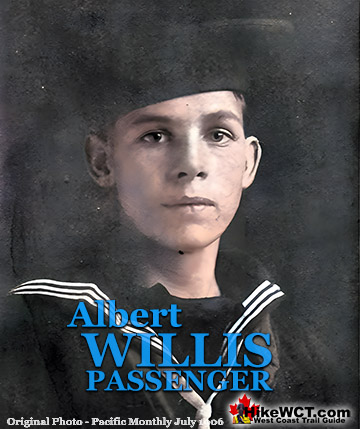
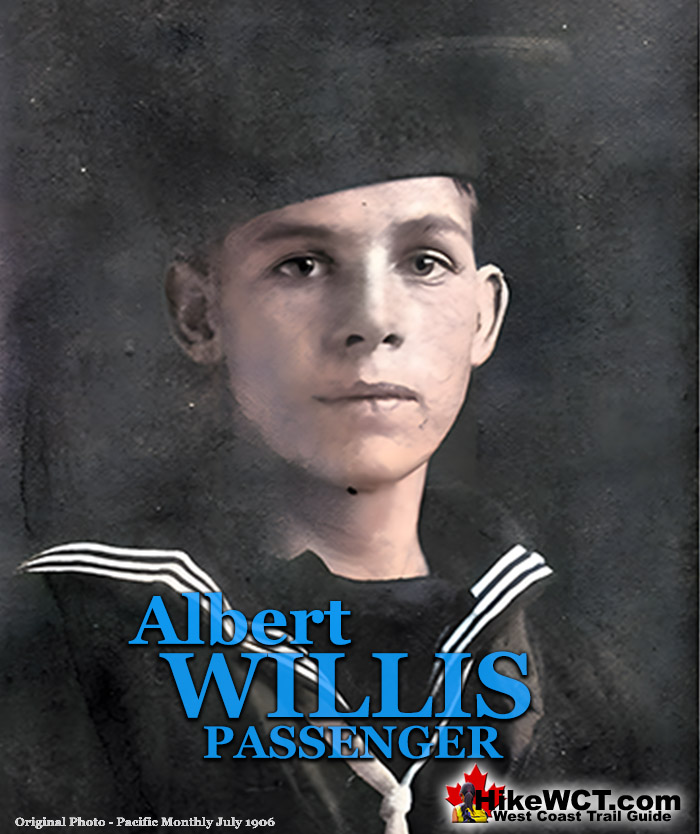
The Valencia Shipwreck on the West Coast TrailAlbert Willis was a 17-year-old United States Navy seaman and second-class passenger aboard the Valencia. He had recently completed his naval training in Pensacola, Florida, and was en route to join his assignment on the USS Philadelphia, which was anchored in Bremerton, Washington.

The Valencia Disaster

 Shipwreck on the West Coast Trail1. The Valencia Shipwreck on the West Coast Trail2. The Voyage Shipwreck on the West Coast Trail3. The Boats Shipwreck on the West Coast Trail4. The McCarthy Boat Shipwreck on the West Coast Trail5. The Bunker Party Shipwreck on the West Coast Trail6. On the Valencia Shipwreck on the West Coast Trail7. The Rafts Shipwreck on the West Coast Trail8. The Turret Raft Shipwreck on the West Coast Trail9. The Rescue Ships Shipwreck on the West Coast Trail10. The Aftermath Shipwreck on the West Coast Trail11. The Survivors Shipwreck on the West Coast Trail12. The Lost 

The West Coast Trail

Shipwreck on the West Coast TrailPrologue Shipwreck on the West Coast Trail1: The West Coast Trail Shipwreck on the West Coast Trail2: When to Hike & Fees Shipwreck on the West Coast Trail3: Trailheads Shipwreck on the West Coast Trail4: Getting There Shipwreck on the West Coast Trail5: Considerations Shipwreck on the West Coast Trail6: Campsites Shipwreck on the West Coast Trail7: Shipwrecks Shipwreck on the West Coast Trail8: Routes Shipwreck on the West Coast Trail9: Sights & Highlights

There were several other men from the US navy on the Valencia and Willis may have been travelling with or at least acquainted with some of them. Willis reported that seaman Clyde William Knight was on the Valencia, though not registered on board. This was later confirmed by the navy along with the other men who did not survive. Ordinary Seaman John Finley, Coal Passer Harman Fisher, Ordinary Seaman Clyde William Knight, Ordinary Seaman Charles Uhler and Coal Passer John Sidney Widmer.

In the frantic and chaotic first hour after the Valencia struck, Willis boarded the No. 3 lifeboat, carrying 15 people. A missing drain plug in the lifeboat was discovered and Willis reportedly plugged with his hand to prevent it from taking on water amid the chaos. About 100 metres from the Valencia the boat lost an oar, veered into the surf, struck a rock, and capsized, resulting in the drowning of eight passengers, including the wife and 16-year-old stepdaughter of fellow survivor Frank Campbell.

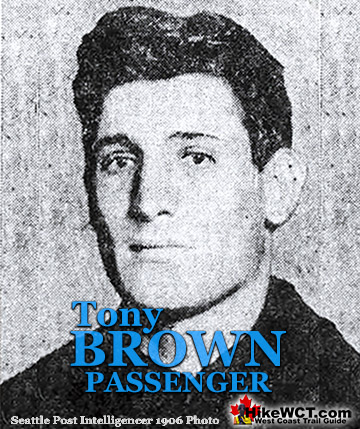
Willis and six other men from the lifeboat—Frank Campbell, Tony Brown, Yosuki Hosoda, Mike Stone, Charles Samuels, and George Billikos—managed to reach the shore at the base of a nearly vertical cliff about 250 meters north of the wreck. They were soon joined by two more survivors from the capsized lifeboat No. 6: Frank Bunker and Frank Richley. This group of nine men, later known as the "Bunker Party," huddled together in freezing, soaked conditions until daylight. Many of the men lost their shoes reaching shore and a thin layer of snow covered the ground. Some had injuries—including an injured finger and possibly broken ribs for Willis—they climbed the cliffs under Bunker's leadership, located a telegraph line, and followed it to a lineman's hut, where they alerted the outside world to the disaster at 1pm on Tuesday, January 23rd. Rescue parties reached them over the incredibly difficult trail, however it was not until 11pm on Friday, January 26th that the Bunker Party with the rescue parties arrived in Bamfield after hiking from Darling River. This amazing photo was taken at about 3:30pm on January 26th, before they started the last long hike from Pachena Bay to Bamfield.

The Bunker Party - January 26th, 1906

Bunker Party January 26th, 1906

Albert Willis Interviewed in Seattle

The Seattle Post Intelligencer on January 29th, 1906 printed an interview of Albert Willis soon after he arrived on the revenue cutter Grant the at 8pm on Saturday, January 27th. Willis describes the terrible ordeal he lived through in graphic detail:

When the ship first struck, I was asleep. The shock awakened me, and I saw people scrambling about putting on life preservers. I was half asleep and scarcely realized what was going on for several moments. It was cold outside, and my bed was warm, so I started to doze off again. But just then came a second shock, which brought to me a full realization of our position. In a second, I was wide awake and listening to the affrighted cries from the deck. There was much confusion. People ran here and there, and there was an absolute lack of discipline. Without delay I tied one of the life preservers around me. It was dark and confusing. The rain was coming down in sheets and the spray dashing over the ship almost blinded me. On getting amidships I found that they were launching the port boat. There was a woman and her daughter standing there and her husband quickly placed them in the craft. All three were cool and took their places without difficulty. I scrambled in after them and got in the stern. Then the sailors lowered away the cutter. It was ticklish work getting out a boat in this sea. She was swung here and there by every wave, and several times I thought I would be dashed to pieces against the ship. But at last it reached the water safely and the men began pulling to sea. All this time I was doing my best to fit the plug in the bottom of the boat. The plug finally went in, but would not hold. In order to prevent the boat from filling, I held my hand over the hole.

The men at the oars pulled like heroes. The wind and sea were both against us. The breakers were like mountains. The searchlight from the ship illumined a broad patch of water. On the ship we could see the people running madly about. It was only a glimpse and then the boat went over like a shot, and was thrown out in the water. Before entering the boat, I had divested myself of my overcoat. Coming to the surface almost immediately, I struck out swimming. I had no sense of direction. All I tried to do was to keep my head above water. In fact, I acted almost unconsciously. There was no time for thought. It was just a mad struggle with the seething water, which choked and strangled me almost to death. Time after time I was buried by the seas, and fought madly to reach the surface, in order to gain a breath of air. No sooner was my head out of the water than once again I was covered by the icy flood and washed towards the rocks. Suddenly the boat swept past me. I caught a glimpse of it in the glare of the searchlight. With a last effort I tried to grasp it. This came near proving my death, for a sea swung it around and the bow struck me a terrible blow in the stomach. After that I remember little except still struggling and finally being dashed against the rocks with terrible force. A wave picked me up, dashed me down, and the undertow swept me back again. Once more this was repeated, and the force of the impact with the rocks almost knocked me senseless, but instinctively I grasped a bit of the ledge and clung like a leech. Sea after sea beat down on me and almost pulled my arms from the sockets as they tried to draw me back. But I clung there. Suddenly my arms were seized by someone on the rock ahead of me and I was drawn up and landed alive, but almost spent, on the spray-covered ledge. There were two other men there. One was Mr. Campbell, who entered the boat with his wife and daughter, and the other was one of the firemen. These two men drew up the fellows who were washed to the cliff. It is due more to Mr. Campbell than anyone else that the nine men from the boat were saved.

When the last man was up, we sat there and waited. It was pitch dark and raining in sheets. The sea came over us and the water from the skies and the cliffs beat our bare heads. The wind seemed to fairly freeze my marrow, and at times I thought I would die. The ledge on which we stood was small. It was im- possible to walk around for fear of falling back into the sea. All we could do was to sit there and wait for daylight. My finger had been smashed on the rock and pained me frightfully. But I believe it was this which kept me alive, It pained so severely that I had no time to think of the rain, the cold or our position. My whole arm seemed numb. Sharp pains shot from my finger clear to my toes and caused the most acute agony. My body was black and blue all over from contact with the rocks, and I ached like a hollow tooth.

The glimpses which we caught of the wreck were few. While the searchlight lasted the picture was terrible. The flying spray was turned to a snowy white by the beams from the light and small rainbows were formed by the mist. People could be seen rushing about the deck on the vessel or clinging to the rigging. With the darkness all around and only this broad beam of light illuminating the picture of death, the scene was such that I still dream of it. Suddenly it went out and the dark night was broken by nothing save the roar of the breakers and the howl of the wind.

How we ever lived out the remainder of the night I don't know. It seemed to be several years long. We could not move till daylight and had to wait. Finally, the gray dawn came. But at that time, I was thoroughly exhausted and so worn out that I scarcely cared whether I lived or died. But Mr. Campbell roused us all and we started seeking the top of the cliff. If it had not been for him, we never would have got up. He cheered us, helped us and guided us, and at last we gained the top. Mr. Bunker was also of great help. In my opinion it is due solely to these two men that we were saved. On reaching the top I took one glance back. The ship appeared to be badly broken. Her stern and part of the cabins were fairly free of the waves and a few people were seen in the rigging and clinging to the deckhouses. Then we started for aid. Campbell and Bunker led the way. Tramping through the woods in our condition was the hardest kind of work. But we kept it up for several miles. Finally, a small shack was reached and from there the first message of the wreck was telephoned in. Everyone in the party was half starved. A few mouldy beans and crackers were found. The Japanese who was rescued from the ship with us acted as cook. After drying our clothes by a fire, we slept in the shack. Next morning the relief party from the cable station reached us, and with them we started for Bam- field. We spent a day along the beach looking for bodies, but found none. At Bamfield we were taken on board the Grant and brought here. I am going to visit my parents if I can secure transportation, as all my money and tickets were lost.


1pm Tues, 23 Jan: Darling River

The Bunker Party had arrived at the Darling River lineman's hut in the afternoon on Tuesday, January 23rd.  Bunker recalled in an interview a few days later.  “In the telegraph hut we found a receiver in a box. There were no directions, but I got it fixed on the wire and succeeded in calling up Mrs. Logan at Clo-oose and when she called her husband, Lineman Logan, I notified him of the wreck and he telegraphed to Lightkeeper Paterson at Cape Beale who gave the news to the world.”  Bunker remembered it was somewhere around 1pm Tuesday, January 23rd when he spoke to Mrs. Paterson of the Cape Beale Lighthouse.  This was thirteen hours after the Valencia wrecked and the first the world would learn of the disaster.  Bunker recalled that he tried to make her understand that there had been a wreck that a steamer had gone on the rocks.  She called her husband, who said he knew where he was.  He told him there were nine in his party and that there were 100 people on board the wreck.  This is when the Bunker Party first learned they were on Vancouver Island and not along the coast south of Cape Flattery in the United States.

3pm Wed, 24 Jan: McKay, Mousley and Richmond Arrive at Darling River

A party of three men from the cable station at Bamfield had started hiking to Darling River at 8am Wednesday morning after hearing the news of the wreck. Lineman McKay, Mousley and Richmond arrived at about 3pm and the beleaguered Bunker Party rushed to them with open arms. The small amount of food they managed to bring with them was passed around to the battered men, who Richmond described as looking like castaways.

11pm Thurs, 25 Jan: Ferris Shore Party Arrive

The shore party from the Salvor led by Captain Ferris arrived at Darling River at 11pm.  They departed from Bamfield and hiked for fifteen miles through the trail to Darling River, which they later described as impassable.  They brought some desperately needed food for the Bunker Party and planned to help them hike back out the next day.  The shore party described the men in the Bunker Party at first sight in one clear sentence. “They were in a bad condition.”  They began the long hike toward Pachena Bay and Bamfield in the morning.

3:10pm Fri, 26 Jan: Second Shore Party from the Salvor Reaches Bunker Party

R.P. Dunn, reporter for the Victoria Daily Times was part of a second shore party from the Salvor sent from Bamfield to further assist the Bunker Party to hike back out. “About 10am Jennings, Topping, Cox and myself set off over the trail upon our own little enterprise.  We carried with us some provisions and a telephone instrument for connecting with the wire in case of obtaining any further news.  After walking for two or three hours over well marked, but very difficult trail we reached Pachena hut.  This is located upon a lovely sandy beach, fully a mile in length, upon which the immense waves boomed, dashing the spray well up towards the bank.  At its extreme eastern end is the mouth of the Pachena River, ordinarily a small, insignificant stream, but then a large volume of water sweeping down from the mountains to the sea with great rapidity.”

R.P. Dunn described the first sighting the Bunker Party.  “The party was sighted at 3:10pm on a point of rock, having taken to the beach as the trail was too hard for the men to navigate in their famished condition.  The Associated Press correspondent was the first to reach them.  He found Frank Bunker, assistant superintendent of schools of Seattle, and Frank Richley on the beach in a bad condition, the latter having walked the whole way suffering from a sprained ankle and experiencing severe pain.  Bunker had lost his coat and shirt and was wearing a blanket with arm holes cut in it.”  A few minutes later more of the Bunker Party arrived.  R.P. Dunn observed that, “All were completely fatigued.  The entire party was equipped with shoes taken from corpses washed ashore.”  In his discussions with the exhausted men, he found that Bunker was, “loudly praised by his fellows, he being a man of great vigor and bravery.  When he reached Pachena he was clad only in his trousers and had his boots tied with a piece of string to hold them together.  His shoulders were covered by a blanket, he having given his shirt to a fellow sufferer.”

11pm Fri, 26 Jan: Bunker Party Arrives Bamfield

On Friday the Salvor’s party returned to Bamfield with the survivors, arriving at the station in the evening in an exhausted condition.  The superintendent and his operators provided the men with everything necessary to make them comfortable.

8pm Sat, 27 Jan: Bunker Party Arrives in Seattle

Daily Colonist 28 reported that, "F.F. Bunker and the other survivors who made their way over the trail, suffering such hardships, were transferred to the United States revenue cutter Grant, after being succored by the Salvor’s crew."