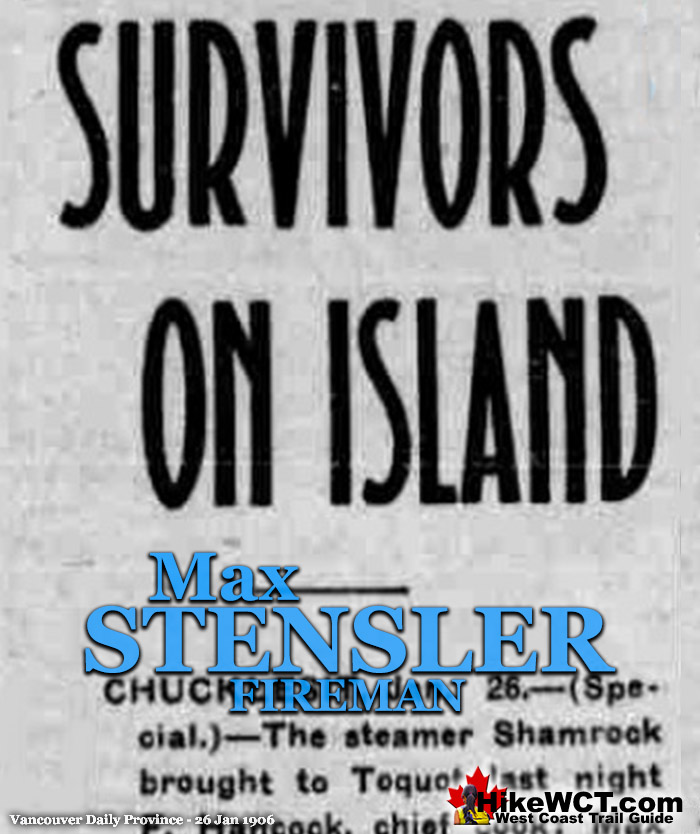
Max Stensler was a fireman on the Valencia who survived on the Turret Raft with Sam Hancock, George Long and Frank Connors. Ten men set off on the raft 34 hours after the Valencia first struck in a desperate attempt to get to ships that arrived, but made no attempts at rescue. He had been working on ships for eight years and his name is misspelled in a variety of ways in newspaper reports.
The Valencia Disaster
1. The Valencia
2. The Voyage
3. The Boats
4. The McCarthy Boat
5. The Bunker Party
6. On the Valencia
7. The Rafts
8. The Turret Raft
9. The Rescue Ships
10. The Aftermath
11. The Survivors
12. The Lost
The West Coast Trail
Prologue
1: The West Coast Trail
2: When to Hike & Fees
3: Trailheads
4: Getting There
5: Considerations
6: Campsites
7: Shipwrecks
8: Routes
9: Sights & Highlights
Constantly washed by waves over the sides of floated partially submerged in the freezing water. They drifted hopelessly up the coast with the current, unable to catch the attention of any vessels. Hours would pass in the freezing, water soaked raft before one of the men succumbed to exposure. With the current dragging them up the coast, they couldn't paddle the unwieldly raft closer to shore and watched helplessly as they passed Cape Beale Lighthouse. Of the ten men that set out on this first raft, only four would survive. The finally made it to the shore of Turret Island after 14 hours on the raft. They wandered the uninhabited island for several hours before they were found.
Departure from the Valencia: 10am, Wednesday, January 24, 1906
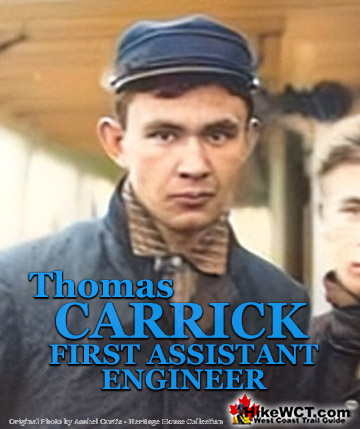
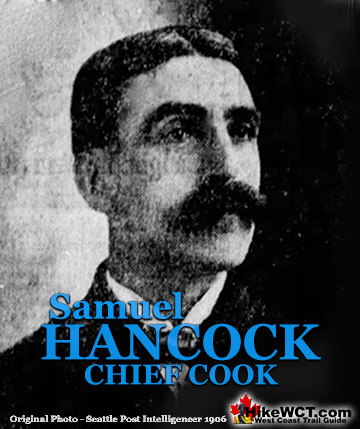
The first life raft, later dubbed the Turret Raft, launched from the wrecked steamship Valencia at approximately 10am on January 24, 1906, just 20 minutes before a second raft. Carrying only 10 men despite a capacity for 18, the raft was led by Third Assistant Engineer Robert Nelson. The crew included chief cook Sam Hancock, waiter Frank Connors, fireman Max Stensler, fireman George Long, waiter John Wallace, passengers Adam Rolph and W. Wilson, and two U.S. Navy men on leave, Harvey Gnegy and an unidentified sailor. Fear deterred others from boarding; many passengers, seeing distant ships, expected swift rescue. Boarding the raft was perilous—requiring a leap from the ship into freezing, surging waters. Frank Connors, one survivor, dove from the maintopmast, striking an underwater object and boarding the raft bleeding from his nose and mouth. The raft cleared the breakers, but waves relentlessly crashed over it, keeping the men soaked and freezing. Cornelius Allison, a survivor from the second raft, later described the ordeal:
“It was terrible on the raft, the water was awfully cold. Our limbs became so benumbed that we could not even move them sufficiently to keep ourselves warm. I thought all would die of exposure. Huge seas came tumbling clean over, burying us beneath them until all suffered from swallowing water while trying to breathe.”
Valencia's First Life Raft, the Turret Raft

Struggling Toward the Queen: 11am, Wednesday, January 24
The men rowed desperately toward the steamship Queen in the distance, which drifted back and forth. Those not rowing shouted and waved frantically during brief moments when the ship appeared atop giant swells. Frank Lehn, watching from the Valencia, noted, “It was a struggle through the breakers, but they finally made it, and disappeared in the distance, swept up the coast by the wind and sea.” After an hour, the current dragged them north, away from the Queen. By 11am, hope faded as the Queen steamed back to Victoria, and two smaller vessels, Salvor and Czar, left for Bamfield to organize a land-based rescue, fearing they might wreck if they approached the Valencia. A miscommunication left the City of Topeka, meant to relieve the Queen, unable to locate the Valencia. The raft, battered by swells and bad weather, became nearly invisible to any ships that might have searched.
Drifting Toward Cape Beale: 11am–3pm, Wednesday, January 24
With rescue hopes gone, the powerful current pulled the raft north. The men, soaked and freezing, spotted Cape Beale Lighthouse in the distance. They rowed toward the rocky cliffs below, but the current proved too strong, dragging them past the lighthouse and further into the abyss.
First Death: 4pm, Wednesday, January 24
After six grueling hours, around 4pm, the unidentified U.S. Navy man succumbed to exposure. R.P. Dunn, interviewing Sam Hancock for the Victoria Daily Times, reported, “So poignant was the disappointment that one of the passengers, who was of more delicate appearance than the others, and whose vitality was unequal to the mental and physical strain gave up the unequal fight and in a few minutes passed away.” To reduce weight and improve their chances, the survivors dropped his body overboard. Harvey Gnegy, the man’s close friend, opposed this, particularly resenting Hancock, who likely pushed for the act.
Despair and Loss: 5pm–6pm, Wednesday, January 24
Around 5pm, passenger Adam Rolph, driven to madness by the relentless ordeal, jumped overboard, believing he could swim to a nearby island. Dunn wrote, “He was beset with all kinds of illusions. Finally, he swore that there was an island a few feet off and that he could swim the distance easily. Suiting the action to the word he precipitated himself into the sea and was never seen again.” Rolph, a New Westminster resident with a wife and five children, had been returning from a failed business venture in San Francisco. His body later washed ashore nearby. Frank Connors recalled, “I saw him dashed against the rocks, we were unable to help him.” By 6pm, as the raft drifted into Barkley Sound’s Broken Group islands, W. Wilson also leaped into the sea, swimming toward a distant island. He drowned, leaving seven men on the raft, barely clinging to life after eight hours of exposure.
Landing on Turret Island: 11pm, Wednesday, January 24
In darkness, the current pulled the raft toward an island. Three men—Robert Nelson, John Wallace, and Harvey Gnegy—were nearly lifeless. Sam Hancock, Max Stensler, George Long, and Frank Connors rowed with their remaining strength, landing on Turret Island between 11pm and midnight after 14 hours of torment. The four able men pulled the raft above the high-water mark and collapsed. Wallace was likely already dead, and Nelson and Gnegy were barely alive.

A Night of Madness: 12am–5am, Thursday, January 25
During the night, Harvey Gnegy, possibly driven mad by his friend’s death, attacked Sam Hancock, believing him to be “a wild dog and good to eat.” The others restrained Gnegy, who collapsed and never moved again. The incident deepened the rift caused by the earlier decision to dispose of the Navy man’s body.
Search for Help: 5am, Thursday, January 25
At dawn, Hancock, Stensler, Long, and Connors left the raft to seek help, believing Nelson and Gregory might still be alive. They wandered into the forest, soon losing their way back to the raft. By 9am, after 23 hours since leaving the Valencia, Connors, showing signs of mental strain, insisted Cape Beale Lighthouse was in the opposite direction. Ignoring his companions’ objections, he headed inland alone. Hancock, Stensler, and Long continued along the shoreline, finding oranges from the Valencia and eating them greedily. They searched for clams and edible vegetation but found none.
Rescue: 12pm, Thursday, January 25
Around noon, Charlie Ross’s sister, a First Nations woman, found Hancock, Stensler, and Long on Turret Island. They were taken to a small settlement and, by 9pm, picked up by the steamer Shamrock. They arrived at Toquart at 10:40pm, cared for at the home of Government Lineman H.J. Helliers.
Search for Connors: 9am, Friday, January 26
On Friday morning, the Salvor received news of survivors on Turret Island and rushed to Toquart, picking up Hancock, Stensler, and Long at 9am. The trio reported that Frank Connors was likely still alive on the island. The Salvor sailed to Turret Island, launching two boats to search—one heading west, the other east.
Discovery of the Raft: 1pm, Friday, January 26
At 1pm, the westward boat, with reporter R.P. Dunn aboard, found the raft in a bay, “lying almost upon its side and upon it huddled a number of limp figures.” The bodies of Harvey Gnegy, Robert Nelson, and John Wallace were aboard. Dunn noted, “One of the men was on his back while the tense muscles of his face and his clenched fists showed how pluckily he had faced death to the last. The second body was lying face downwards. The third (Nelson) was in its bare feet, which were swollen with the cold.” The raft was lodged in the surf, and Dunn jumped ashore to attach a painter for towing. The raft was eventually towed to the Salvor.
Connors Found: 2pm, Friday, January 26
The eastward boat found Frank Connors at 2pm, lying on a log in the sun about a mile from the raft. He was rescued and brought aboard the Salvor.
Return to Victoria: 4pm, Saturday, January 27
The Salvor arrived in Victoria at 4pm on Saturday, January 27, with Frank Connors and George Long. Sam Hancock and Max Stensler continued to Seattle.